
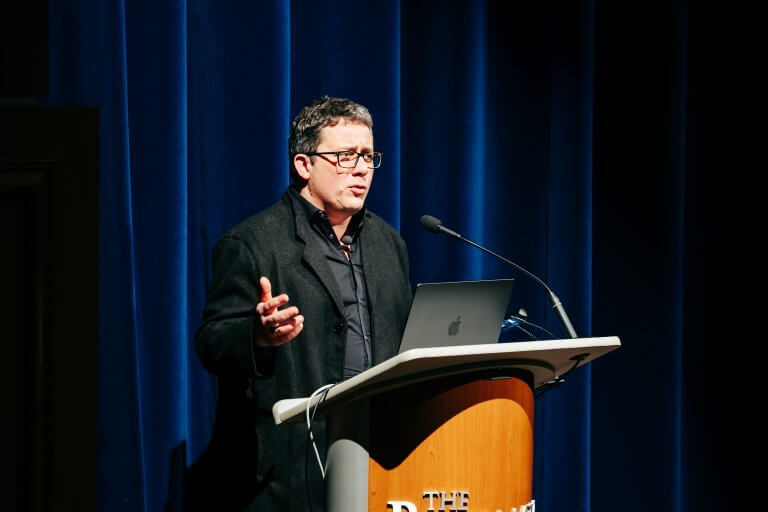
The Max Planck Florida Institute for Neuroscience (MPFI) welcomed audiences to the second Science Meets Music concert event of the 2026 season on February 11. Featured lecturer and pianist Dr. Moritz Helmstaedter, Director at the Max Planck Institute for Brain Research, shared insights into the intersection of brain science and music.
Dr. Helmstaedter took the audience on an expedition through the neural networks, revealing that the same systems that support memory and learning also allow us to recognize, anticipate and emotionally connect with our favorite music.
Mapping the Brain’s Networks
Dr. Helmstaedter’s research pushes the frontiers of connectomics, which is the study of neuronal network architecture in the brain at unprecedented scale and resolution. His work focuses on investigating how complex neural networks are organized in the brain and how these networks support higher cognitive functions such as memory.
These same networks, he explained, play a critical role in how we process music—enabling us to recognize familiar melodies, recall favorite pieces and form emotional associations with sound. Whether it’s the opening notes of a symphony or a song that evokes a personal memory, our brains rely on finely tuned neural circuits to link sound with meaning.
The methodological advances of his laboratory are enabling research to search for connectomic phenotypes of neurodevelopment, aging and psychiatric disorders.
In 2024, he was awarded the €2.5 million Leibniz Prize for his neuroscience contributions, which have led to a fundamentally new understanding of the three-dimensional organization and function of neural circuits in the brain.
How the Brain Anticipates Music
During his presentation, Dr. Helmstaedter guided the audience through the concept that memories are not stored in a single place; rather, they emerge from intricate patterns of neuronal connectivity.
In a highlight of the evening, Dr. Helmstaedter discussed how the brain creates predictions, or expectations, in light of past experiences—a fundamental principle of how the brain works. As we listen to music, he explained, our brains constantly predict what will come next based on patterns we’ve learned over time. Expectations shape our experience with the music, creating feelings of comfort, surprise or even tension.
Composers intuitively understand this process, Dr. Helmstaedter noted. By establishing musical patterns—and delaying or breaking them—their music engages the brain’s predictive machinery, sometimes satisfying expectations and sometimes artfully subverting them.
This dynamic interplay explains why music can be so emotionally engaging. Dr. Helmstaedter demonstrated this by performing moving piano selections from Johann Sebastian Bach’s Partita No. 1, Goldberg Variations and English Suite No. 2.
When Science and Music Converge
Science Meets Music demonstrates MPFI’s commitment to making neuroscience accessible and engaging for the global community. The annual series is a compelling reminder that science and art share a common goal: helping us better understand ourselves.
Join us March 24, 2026, for the final concert of the season featuring Dr. Sarah Stern, Research Group Leader at MPFI. Dr. Stern will present “Rewiring Appetite: How the Brain, Hormones, and Modern Life Shape Our Eating Habits.”
Dr. Stern will explore how neural circuits integrate internal signals like hunger and hormones with external factors, revealing data to inform human behavior and emerging medical therapies. Arnaud Sussmann and the 2026 Rising Artists of the Chamber Music Society of Palm Beach will perform classical musical selections in this finale event.
Science Meets Music is free and open to the public, and advanced registration is required. Reserve your seat for the final 2026 Science Meets Music event.




Leave a Reply